Showing posts with label Classicism. Show all posts

Saturday, 7 December 2013

Venus of Cnidos (Roman Copy)

c. 340-330 BC.
The Venus of Cnidos is a Roman copy of the one formerly sculpted by Praxiteles. It acted as the first free-standing female nude and was created to be viewed from all angles.

The pose of the goddess, in which her right hand shields her genitals, was created to draw the eye to what she was intentionally covering. Such a stance was then named Venus Pudica. 

Praxiteles was commissioned by the people of Kos for a statue of Venus. He created two versions: one in full drapery the other (shown on the left) that was nude. Until then, a female nude deity was unheard of and so the people of Kos accepted the fully clothed sculpture. However, the people of Cnidos had decided to accept Praxiteles nude one and created a round temple with the piece located in the centre.

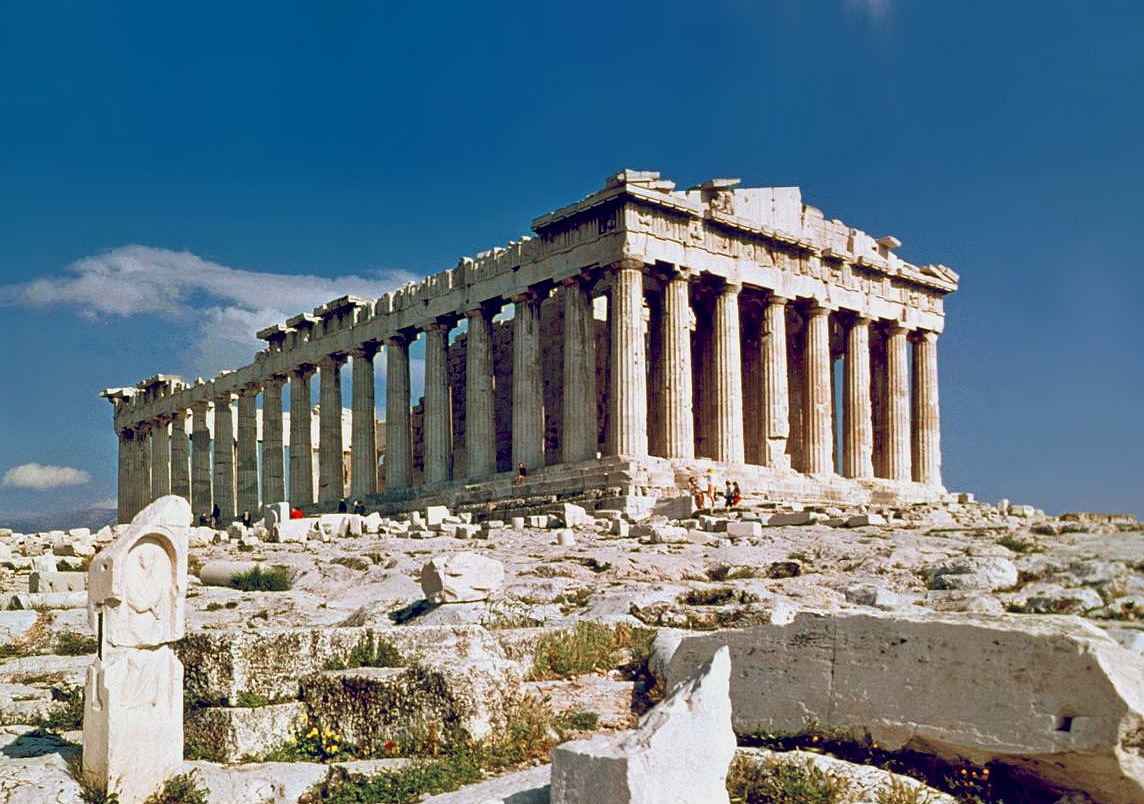
The Parthenon

c.447-432 BC. Athens
The Parthenon is perhaps the most well-known piece of Classical architecture to have survived.

It showed both Doric and Ionic orders. In which the Doric is the masculine order and ionic as the feminine.

The columns are simple and supports a structure which contains alternating metopes and triglphys. However, there is another layer of columns between the Doric ordered columns and the temple. It is here where instead of the frieze being broken into metopes and triglyphs, it is just a single continuous frieze (only seen in the Ionic order).

The columns itself were shaped wider at the bottom than the top to create an optically straight column.

The frieze itself is perhaps the most notable of the Pantheon. Over the years, it has gained international news coverage over its location. 

The artwork carved into the frieze (metopes) was used as a form of propaganda. It formed a sense of identity after the recent Persian invasion. 

The frieze was considered unusual for its day and age as it featured humans as well as deities. It showed a procession of what could be interpreted as the Panathenaia - a procession in which a peplos is handed over to the goddess Athena. The deities were scaled much larger than the humans but it conveyed a sense in which the human world interacted with the divine world. 

The sculptural form that is produced by the architects create a strong sense of movement, momentum and dynamics within such a hard and dense medium, reflecting the skill of the Classical sculptors. All the riders and horses resume similar positions yet all are different, the anatomy of the horses depicted lends itself to the momentum of the frieze. In addition the swooping drapery allows the spectator to understand the flow of the procession.  


Riace Bronzes

C. 470-460 BC. Warrior A (left) and Warrior B (right)
The Riace Bronzes were originally a collection of statues. However, most of them were melted down over the century or lost in the shipwreck when they transported to Rome. 

They were not only made of bronze. For example, silver was used for their teeth.

Both statues have a wondering gaze in their eyes and intentional sharp features.

Nudity within Classical art was a norm. It often symbolised heroism.

Warrior A (right) and Warrior B (left)
Between the two, it has been estabilished that Warrior A is the younger of the two statues. Art historians have come to this conclusion due to Warrior B's less defined stomach and the curvature of his spine.

Warrior A was created with accuracy vs style. This is shown through the juxtaposition between the hip joint and his back.